Chapter 1: The Unconscious Self
CHOOSING PRESENCE PP. 9-12

Summary for Chapter 1
The Unconscious Self: Understanding the Origins of Our Stress and Anxiety
Much of our stress and anxiety stem from living in an unconscious state, where the mind fixates on past regrets or future worries rather than the present moment. Jim Heaney explains how the ego fuels compulsive thinking patterns that generate fear, self-doubt, and suffering.
Negative emotions, especially fear, are often based on false narratives rather than reality. When these emotions take control, they create inner turmoil and distance us from God’s presence. However, awareness offers a way out. Recognizing that thoughts are not absolute truth allows for a shift into conscious presence, where peace is always available.
Practicing presence weakens the grip of ego-driven fears and strengthens the connection to God’s peace. Heaney introduces simple breathing exercises and reflective questions to help cultivate this awareness and break free from unconscious patterns.

Chapter 1: Making Meaning of the Message
As we practice presence in our daily lives, our awareness changes. We realize that not just some but almost all our inner fears and conflicts—our stress, anxiety, worry, and lack of self-esteem—arise when we are in an unconscious state living through memory or anticipation, being led by our ego mind. It becomes very clear to us that when our thoughts become compulsive and repetitive, they become useless and anxiety producing. If some of us doubt that that is the case, all we must do is ask ourselves in those times of inner distress, 'Am I present now?' The answer will always be no.
That is why the practice of presence is so essential. We cannot create inner chaos in the present moment. Fears do not exist in the present moment. Even if we are suffering, we don’t feel alone and isolated because there is a sense of God’s peace around the suffering. We are not alone.
Once we realize through the practice of presence that we have allowed that voice in our head, our negative ego, to control too much of our life, that is the beginning of the end of self-created suffering. Through the peace of the present moment, we have a true alternative, a true perspective of reality now. We are grounded in the only reality there is: this moment—the only access point to God’s Spirit within us and an intimate relationship with the divine.

Jesus asked his disciples, “Why were you afraid? Don't you have any faith?”

The Practicing Presence Journal
Set aside a dedicated space for your reflections on practicing presence—whether it’s a lined notebook, a digital document, or a note-taking app on your phone. Use it to explore the journaling questions provided in the PDF below. We encourage you to revisit these prompts throughout the week and notice how your responses may shift as your experience of presence deepens.
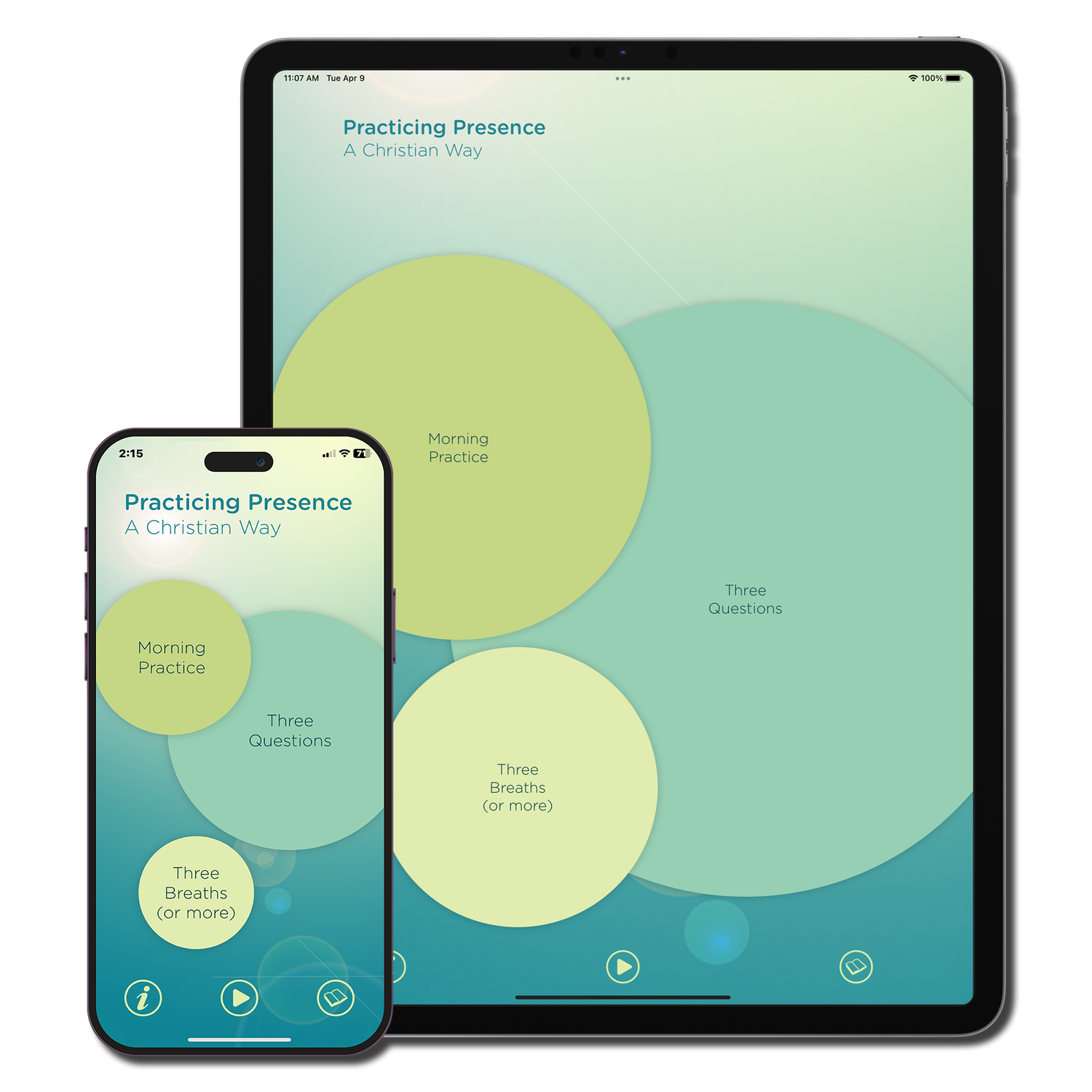
Download the Free
Practicing Presence App
➜ Start with the Morning Practice.
➜ Be sure to enable hourly notifications and reminders.
➜ Simple to install and easy to use.
➜ Check out our download and installation tutorials.




Guided Practice of Presence
The Practice of Presence is about shifting from unconscious, fear-driven thinking to an awareness of the present moment, where God’s peace is always available. Below are step-by-step instructions to guide you through this practice:
-
Sit in a comfortable, upright position in a place free from distractions. Keep the spine straight, and if possible, close your eyes to minimize external stimulation.
-
Before starting, acknowledge the purpose: to quiet the mind, become present, and connect with God’s peace. A simple prayer can help:
“God, all goodness comes from You. Let Your peace flow through me.”
-
Use the breath to anchor awareness in the present:
Take a slow, deep breath in through the nose, filling the lungs completely.
Hold for a brief moment, feeling the stillness.
Slowly exhale through the nose, releasing tension.
Repeat this cycle for several breaths.
To deepen your focus, silently repeat a sacred word like “Jesus” or “Yahweh” on each inhale and exhale.
-
As the inner noise settles, begin to notice a deeper sense of peace. This is where God’s Spirit is most accessible. Rather than striving for an experience, allow presence to unfold naturally.
-
Practicing presence is not just for morning meditation—it’s a way of living. Remember to take three conscious breaths throughout the day.
Ask yourself these three questions:
If I am at peace, do I know why?
If I am not at peace, do I know why?
If I am not at peace, do I know how to get back to peace?
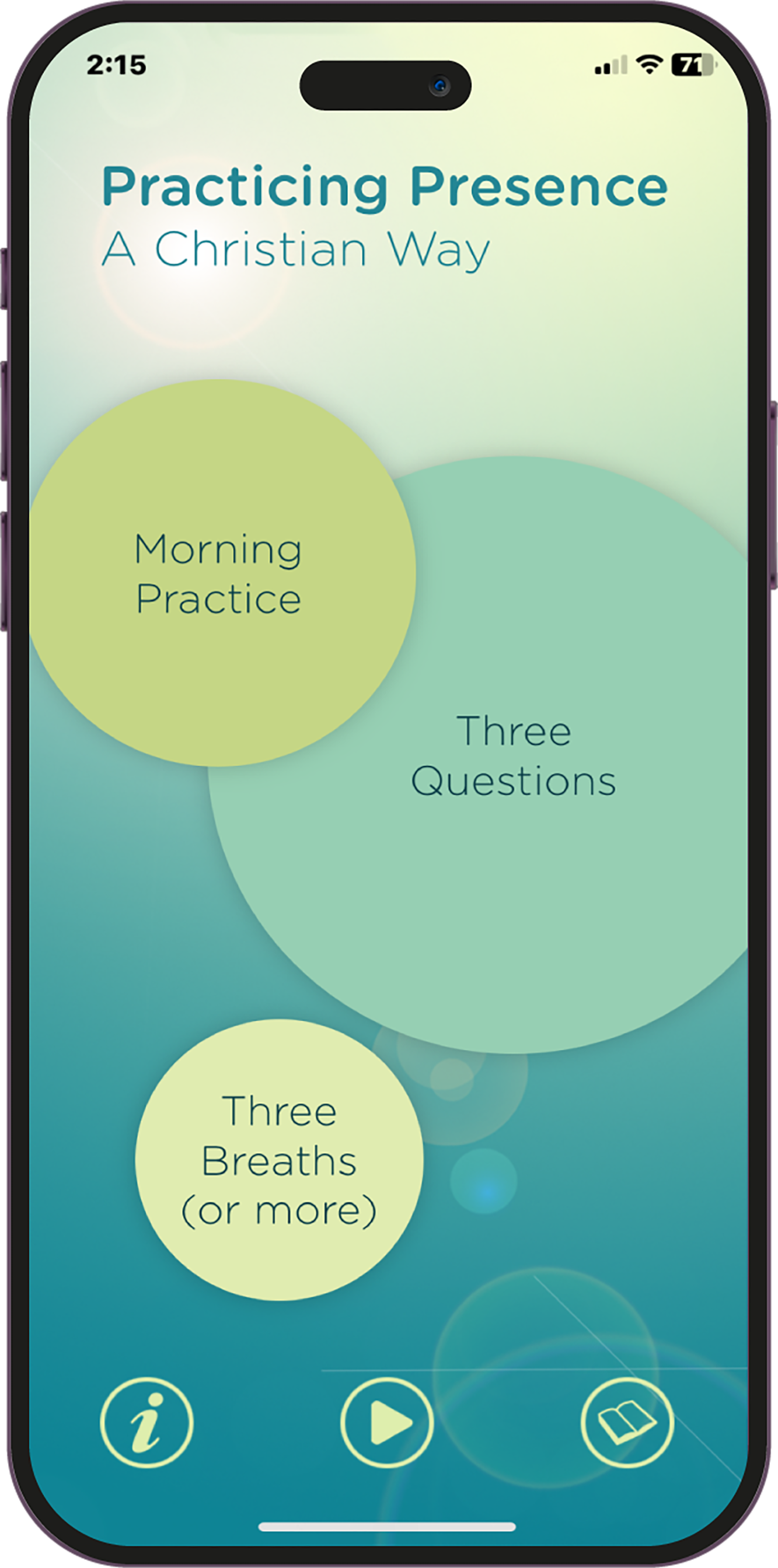
Use the Practicing Presence: A Christian Way App to do the actual practice and the hourly intention.